Providing the analytics Behind Vaccine Decisions
Recent changes to the U.S. childhood vaccine schedule have left states, payers, and families facing critical decisions without the quantitative evidence that has historically guided vaccine policy. Modeling was not used to inform these unprecedented schedule changes, leaving decision-makers without the cost-benefit and health outcome projections they need.
Our team is filling that gap. Emory leads two large academic modeling consortia (CIDMATH and CAMP) with over a decade of experience providing actionable data to public health decision-makers. We are now conducting independent modeling amid a rapidly shifting vaccine landscape. Our recent analysis of potential impacts of changing the Hepatitis B birth dose recommendation (Hall et al., 2025) ranked in the top 1% of scientific literature for breadth of dissemination and was widely used across sectors.
We work for the people making decisions. Our modeling serves regional coalitions, states, and payers—grounded in programmatic needs and aligned with policy realities. We have a track record with federal agencies, state health departments, patient advocacy organizations, and clinical associations, and our communications team translates complex findings for diverse audiences.
Keywords:
Mathematical modeling, Vaccine impact, Vaccine evaluation, Economic analysis, Vaccine policy
Core faculty:
Ben Lopman, Heather Bradley, Eric Hall, Kristin Nelson
RECENT PROJECTS
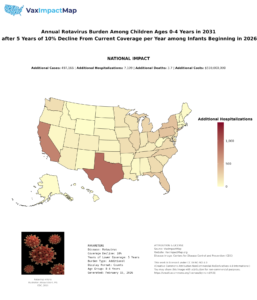
VaxImpactMap uses epidemiological models and state-level data to project the additional disease cases, hospitalizations, deaths, missed workdays, and health care costs that would occur at different levels of declining vaccination coverage.
Three major vaccine-preventable childhood diseases—rotavirus (diarrheal disease), pertussis (whooping cough), and pneumococcal disease (serious bacterial infection)—were featured on VaxImpactMap’s initial launch.
Affiliated Faculty:
Ben Lopman PhD, Kristin Nelson PhD
Collaborators:
Emory University
This work was widely used across multiple sectors and ranked in the top 1% of scientific literature for breadth of dissemination. We have also created interactive state-level maps that visualize the likely health and economic impacts of reduced childhood vaccine coverage.
Affiliated Faculty:
Heather Bradley PhD, Eric Hall PhD
Selected Publications:
- Eric W. Hall, Prabhu Gounder, Heather Bradley, Noele P. Nelson. Economic evaluation of delaying the infant hepatitis B vaccination schedule.
Using a decision-analytic model with Markov disease progression, this study evaluated the cost-utility of expanding hepatitis B vaccination to all US adults, finding that universal vaccination could avert roughly one-quarter of acute hepatitis B infections at an incremental societal cost of approximately $150,000–$155,000 per QALY gained. These findings directly informed the 2022 ACIP decision to recommend universal hepatitis B vaccination for all adults aged 19–59 years, removing the prior requirement for individual risk-factor assessment — a change expected to meaningfully increase vaccination coverage and reduce hepatitis B burden in the United States.
Funder:
National Center for HIV/AIDS, Viral Hepatitis, STD and TB Prevention (NCHHSTP),
Affiliated Faculty:
Heather Bradley PhD, Ben Lopman PhD, Eric Hall PhD
Selected Publications:
- Eric W Hall, Mark K Weng, Aaron M Harris, Sarah Schillie, Noele P Nelson, Ismael R Ortega-Sanchez, Elizabeth Rosenthal, Patrick S Sullivan, Ben Lopman, Jeb Jones, Heather Bradley , Eli S Rosenberg. Assessing the Cost-Utility of Universal Hepatitis B Vaccination Among Adults. J Infect Dis. 2022 Sep 21;226(6):1041-1051. doi: 10.1093/infdis/jiac088.
- Mark K Weng, Mona Doshani, Mohammed A Khan, Sharon Frey, Kevin Ault, Kelly L Moore, Eric W Hall, Rebecca L Morgan, Doug Campos-Outcalt, Carolyn Wester, Noele P Nelson. Universal Hepatitis B Vaccination in Adults Aged 19-59 Years: Updated Recommendations of the Advisory Committee on Immunization Practices – United States, 2022. The Journal of Infectious Diseases, Volume 226, Issue 6, 15 September 2022, Pages 1041–1051
The goal of this project is to inform SARS-CoV-2 vaccine deployment and inform policies regarding mitigation and control strategies as a vaccine is rolled out. This is accomplished by determining the relative importance of direct and indirect transmission pathways, identifying viral immune escape, gauge its epidemiological consequences, and determine the population-level impact and optimal allocation of a future SARS-CoV-2 vaccine.
Funder:
NIH, WHO
Affiliated Faculty:
Ben Lopman, PhD and Katia Koelle, PhD, Juan Leon, PhD
Collaborators:
Alicia Kraay, Andreas Handel
Selected Publications:
- Gallagher ME, Sieben AJ, Nelson KN, Kraay ANM, Orenstein WA, Lopman B, Handel A, Koelle K. Indirect benefits are a crucial consideration when evaluating SARS-CoV-2 vaccine candidates. Nat Med. 2021 Jan;27(1):4-5.
- Kraay ANM, Nelson KN, Zhao CY, Demory D, Weitz JS, Lopman BA. Modeling serological testing to inform relaxation of social distancing for COVID-19 control. Nat Commun. 2021 Dec 3;12(1):7063.
- Modeling the use of SARS-COV-2 vaccination to safely relax non-pharmaceutical interventions. Preprint.